By Baphiwe Mlondo
In the world of law enforcement and crime-solving, the ability to accurately identify human remains can be a matter of justice and closure. Traditional methods used to determine a decedent’s age, sex, ancestry, and stature often rely heavily on the expertise of forensic anthropologists. However, these methods are not without their flaws; they introduce a level of subjectivity that can lead to inconsistencies.
The need for more reliable identification methods has never been more pressing. As wrongful identifications can have devastating consequences, researchers are turning to artificial intelligence (AI) and deep learning to enhance forensic analysis. These technologies offer the promise of more objective and efficient methods, reducing human bias in the process.
Recent research by Yi et al. (2021) has explored the potential of deep convolutional neural networks (DCNNs) to analyse chest radiographs for age and sex estimation. Their study utilised a substantial dataset of 112,120 chest X-rays, balanced between male and female subjects across various age groups. The DCNN was trained on this data, having first been pre-trained on the ImageNet database to build a robust foundational understanding.
The results were compelling. The model effectively identified key anatomical features, revealing that it focused on the sternum and upper ribs in 94% of images during sex estimation, with no activation in breast tissues (Figure 1). For age estimation, the DCNN highlighted specific bony structures in 56% of cases for individuals under and over 18 years (Figure 2) and emphasised the diaphragmatic region in 62% of images for ages 11–18 (Figure 3). These findings indicate that the model learned meaningful patterns associated with biological differences, validating its potential as an objective alternative in forensic identification.
While the promise of these advancements is exciting, challenges remain. Ensuring the model’s accuracy across diverse populations and ongoing evaluation of its effectiveness in real-world scenarios are critical. As we stand at the crossroads of technology and forensic science, deep learning holds the potential to redefine how we approach the identification of human remains, paving the way for a future marked by precision and reliability.
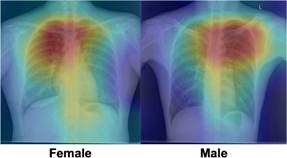
Figure 1. Heatmaps for deep convolutional neural networks focusing on the sternum and upper ribs for prediction of female and male sex

Figure 2. Heatmaps for deep convolutional neural networks focusing on bony structures to determine the age

Figure 3. Heatmaps for deep convolutional neural networks focusing on the diaphragmatic region to determine the age
References
Yi, P.H., Wei, J., Kim, T.K., Shin, J., Sair, H.I., Hui, F.K., Hager, G.D. & Lin, C.T. 2021. Radiology “forensics”: determination of age and sex from chest radiographs using deep learning. Emergency Radiology. 28(5):949-954.

 Health Science Reviews
Leave a comment