by Saba Gebreseilassie
Why is it that your memories aren’t all jumbled up and follow a chronological pattern? If the cells that encode memories aren’t all aligned in a nice, neat row with one after the other, how could they possibly know not just what happened, but when? The answer: time cells. Yes, time cells: neurons that encode time separately to the ones encoding memory make sure that even outside of the what and where of it all, you know the when. Let’s explore how scientists defined time cells and how their existence and mechanisms were confirmed through experimentation.
In 2011, researchers (MacDonald et al.) discovered that when a rat was tasked to move through a path with the goal of remembering an object, there were still cells in the hippocampus that fired when the rat was in a delay period. With no external stimuli, the rat was still keeping track of…well, time! This phenomenon was evidence of ‘time cells’, which are similar in function to ‘place cells’ which were discovered and defined earlier. While place cells fire when a subject is in a certain place, time cells fire at regular intervals during a given period. For example, some cells fire at a start period, others at an end period, some at a relative middle and others at various points in time based on an expected delay. When this delay is changed, the time cells adjust their firing to match the new predicted delay.
You might wonder, if the delay is the same and the sequence of events is similar (e.g. waiting period in a doctor’s office vs same waiting period for a restaurant reservation) then how do you differentiate between events in a certain memory? Would they not all get muddled up because there are similar timing patterns? And here’s the kicker of the story: the time may be the same, but the cells encode time differently for different memories depending on the initial event and context! So even if the time is the same, your memories will be separate. This is achieved by dedicating cells to different times in different sequences.
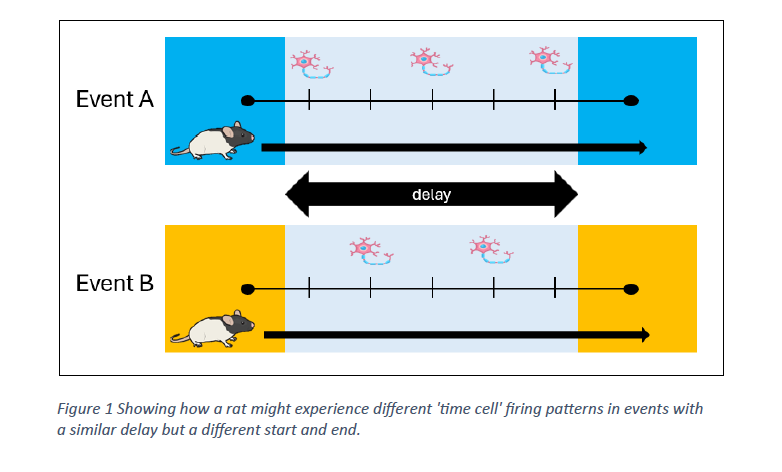
Imagine Event A is waiting to be seen in a doctor’s office. Time cells would fire in a sequence based on the context of arriving at the hospital and being assigned a seat by the hospital admin, as well as present symptoms. Likewise, imagine that event B is waiting in line for a restaurant reservation. Cells would fire in a different sequence based on context of arriving with a lovely date and a large appetite. These differences mean that the memory of waiting for 30 minutes is not isolated but integrated with context, which is encoded during memory formation.
Why is this important? It offers insight into how the brain distributes tasks to specialized regions of the brain and informs research approaches. Although there are various aspects to a certain function, the individual counterparts are brought together to form a final thought, memory, or process. This can potentially help design treatments of memory disorders and help build models and neural networks.
And that’s how you know your birthday party came before your final exams but after that terrible haircut. Your hippocampus has receipts.
The complexity of this process and how the researchers used object memory and identification as well as computational models to understand how these cells work can be explored further in the paper: Hippocampal “time cells” bridge the gap in memory for discontiguous events.
References:
Christopher, Kyle, Uri, & Eichenbaum, H. (2011). Hippocampal “Time Cells” Bridge the Gap in Memory for Discontiguous Events. Neuron, 71(4), 737–749. https://doi.org/10.1016/j.neuron.2011.07.012

 Health Science Reviews
Leave a comment