By Emelinah Silinda
Did you know that in recent years, the potential of pyroptosis in the treatment of tumours has received increasing attention and has become a promising anti-tumour therapeutic strategy?
Pyroptosis refers to a rapid, inflammatory form of cell death caused by the activation of an inflammasome. There are some chemotherapies, such as doxorubicin and topotecan have been confirmed to induce cell death by triggering pyroptosis via casp3/GSDME pathways.
However, despite significant efforts in cancer treatment, drug resistance remains a major obstacle. This is largely because cancer cell membranes are impermeable, and in most cases, the drug is actively pumped out of the cells by a P-glycoprotein. As a result, there has been an emerging attention towards finding compounds that can target the cancer cell membranes and induce pyroptosis.
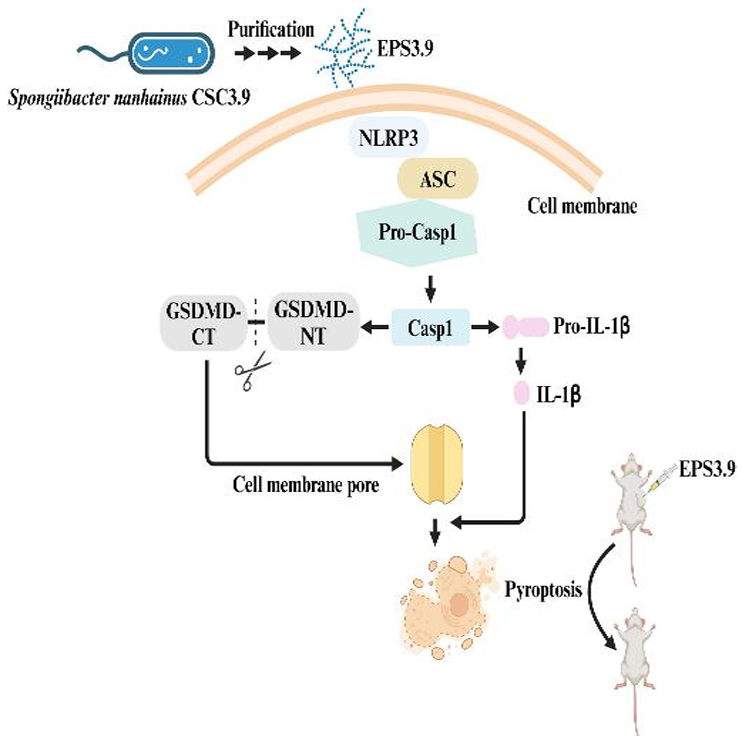
In this study, the researchers discovered a new sugar compound that simultaneously targets cancer cell membranes and, in turn, activates immune responses. To do this, they isolated a long-chain exopolysaccharide (EPS3.9) from a marine bacterium Spongiibacter nanhainus strain CSC3.9, a new species within the genus Spongiibacter. In vitro studies were conducted in THP-1 cells to test the activity of pyroptosis, and in vivo experiments were done using mice with lung tumours to evaluate antitumour effects. Both in vitro and in vivo experiments showed that EPS3.9 destroys cancer cells by directly interacting with five (5) phospholipids in the cell membrane, inducing NLRP3/Casp1/GSDMD-dependent pyroptosis, and thereby stimulating pyroptosis in human leukaemia cells.
Mechanism of action:
The Exopolysaccharide (EPS3.9) binds to 5 different phospholipids in the tumour cell membrane and activates
NLRP3 inflammasome, a protein complex involved in the detection and activation of caspase 1. Caspase 1, in turn,
activates the pro-inflammatory cytokines (IL-1β and inIL-18) and cleaves gasdermin D (GSDMD), which forms pores or holes in the cancer cell membrane, resulting in cell inflammation and bursting, a hallmark of pyroptosis.
Although the study has proven, without any reasonable doubt, that EPS3.9 exhibits significant anticancer effects both in vitro and in vivo, representing a novel mechanism underlying the anti-tumour activity of polysaccharides in medicine, there is a need for further research, reliability testing and clinical trials to confirm the preclinical findings and monitor long-term cytotoxicity.
References
Liu, G., Shan, Y., & Sun, C. (2025). A Novel Exopolysaccharide, Highly Prevalent in Marine Spongiibacter, Triggers Pyroptosis to Exhibit Potent Anticancer Effects. FASEB journal: official publication of the Federation of American Societies for Experimental Biology, 39(14), e70758. https://doi.org/10.1096/fj.202500412R

 Health Science Reviews
Leave a comment