By Abigail Clemo
We all know that a healthy lifestyle is essential to live long and prosper. Boring, but necessary nonetheless. Unhealthy habits can exacerbate the natural reduction in brain volume that occurs with ageing. Smoking, heavy alcohol consumption, obesity, physical inactivity and short sleep are risk factors for health conditions like hypertension, diabetes, increased (neuro)inflammation, which can affect brain structures. Notably, the hippocampus (involved in memory) and total grey matter volume (neuronal cell bodies) are sensitive to this inflammation. The consequences of unhealthy lifestyle behaviours may be cumulative, with co-occurrence increasing the risk of health problems. While these factors have been linked to dementia and cognitive decline, the cumulative effect of unhealthy lifestyle factors on brain structure is largely unknown. A study by Binnewies and colleagues (2023) examined the effects of lifestyle risk factors of smoking, physical inactivity, short sleep, alcohol use and obesity on hippocampal and total grey matter volume.
Participants were sampled from 8 cohorts over 7 European countries. The lifestyle factors body mass index (BMI), physical activity, smoking, sleep duration and alcohol use were measured and deemed healthy or unhealthy through cut-off values outlined in public health guidelines. A summed unhealthy lifestyle score was created and magnetic resonance imaging (MRI) was used to acquire hippocampal volume, total grey matter volume and total intracranial volume, analysed by FreeSurfer software. Findings show that the cumulative effect of these behaviours was associated with the participants hippocampal and total grey matter volume. Binnewies and colleagues dug deeper and found that heavy alcohol consumption was the only factor associated with decreased hippocampal volume (Figure 1). This is consistent with the literature on the effects of alcohol and memory – too much alcohol causes ‘blackouts’ and indistinct memories in the short term, as well as longer-term memory deficits. Binnewies and colleagues also found that reduced total grey matter volume was associated with obesity and smoking, but surprisingly not associated with physical inactivity, short sleep and heavy alcohol consumption (Figure 1). Physical inactivity was uncommon in the sample so statistical power was low. Short sleep has been linked to reduced brain volumes, but some researchers suggest that sleeping issues and daytime tiredness could have more impact on brain structure than nightly sleep duration. Powering through tiredness at work leads us to reach for stimulants like caffeine which can cause further sleep problems, thus perpetuating sleep disturbances and potentially affecting brain volume and functioning. A higher unhealthy lifestyle score was significantly correlated with lower total grey matter volume. This matches the hypotheses that higher neuroinflammation arising from unhealthy behaviours has negative effects on grey matter.

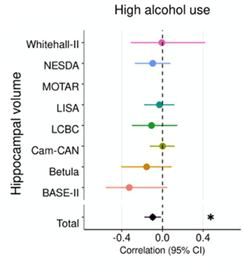
Figure 1. Forest plots showing correlations of lifestyle factors and volume of brain structures (coloured dots) according to individual cohorts. Horizontal lines show 95% confidence intervals, and asterisks show significance of pooled correlation (p<005).
As mundane as it is maintaining a healthy lifestyle, it has more than just aesthetic benefits – it can protect against loss of grey matter volume and potentially dementia and cognitive decline. Luckily, it’s cheaper not to buy cigarettes and alcohol than it is to buy them, and it exercise is free. Thus you’ll enjoy more money in your longer, healthier future!
References
Binnewies, Julia, Laura Nawijn, Andreas M. Brandmaier, et al. “Lifestyle-Related Risk Factors and Their Cumulative Associations with Hippocampal and Total Grey Matter Volume across the Adult Lifespan: A Pooled Analysis in the European Lifebrain Consortium.” Brain Research Bulletin 200 (August 2023): 110692. https://doi.org/10.1016/j.brainresbull.2023.110692.
Fjell, Anders M., Øystein Sørensen, Yunpeng Wang, et al. “Is Short Sleep Bad for the Brain? Brain Structure and Cognitive Function in Short Sleepers.” The Journal of Neuroscience 43, no. 28 (2023): 5241–50. https://doi.org/10.1523/jneurosci.2330-22.2023.
Watson, Emily, Alison Coates, Mark Kohler, and Siobhan Banks. “Caffeine Consumption and Sleep Quality in Australian Adults.” Nutrients 8, no. 8 (2016): 479. https://doi.org/10.3390/nu8080479.

 Health Science Reviews
Leave a comment