By Boniwe Ncethelo
Have you ever watched a heist movie and funny how most times we side with the criminals because we admire how smart they are, for instance in the series that was popular in 2017: Money heist. I was on the criminal side. I know it sounds bad, but they were just so smart that you too will be on their side because they are all geniuses. I do not encourage that though but sometimes being smart is admirable. I told myself I will stop admiring the bad guys but unfortunately, i am at it again admiring how parasites are so smart just like The Professor from Money heist.
Parasites are organisms that live in or on other living organisms (host) and derives benefits from it at a cost to the host, this cost can be anything from using small amount of the host’s food to causing a fatal illness. Similar to a roommate who never pays rent, eats your food and doesn’t contribute to groceries, doesn’t clean and they do not leave. The brain, my favourite organ and happens to be my major, is a very delicate structure. The brain is protected by the skull, meninges and most importantly it has the blood brain barrier (BBB) which ensures that no substances from blood cross over to the brain or else its GAME OVER, things will turn sour. However, parasites somehow manage to bypass all this structures and enter the brain.
You might then be wondering How? Well, the paper by Masocha & Kristensson (2012) aims to answer that question by investigating the routes used by two neuropathogenic parasites, Trypanosoma brucei spp and Toxoplasma gondii to go across the BBB and the consequences that occur when these parasites have invaded the Central nervous system (CNS). Using various models and techniques such as in vitro models of the human BBB (co-cultures of endothelial cells and astrocytes) to assess parasite crossing, in vivo infection models using rodent strains (e.g., C57BL/6, BALB/c, SV129/Ev) infected with T. brucei or T. gondii to assess parasite entry into the brain and CSF and plasma cytokine analysis of patients affected by the parasites. The results show that these parasites can change the host immune system to tolerate them by inhibiting the Th1 which fights intracellular pathogens and Th2 which is against extracellular pathogens therefore this allows them to be able to live in the host with no inhibition. Furthermore, these guys use the very routes that cannot be closed like the Cerebrospinal fluid routes & across the fenestrated vessels in the choroid plexus, so they move in the ventricles and move with the CSF. What’s worse is that they can enter through the olfactory route – from the olfactory epithelia in the nasal cavity along the olfactory nerve into the CSF and brain. I mean where will you hide your nose?
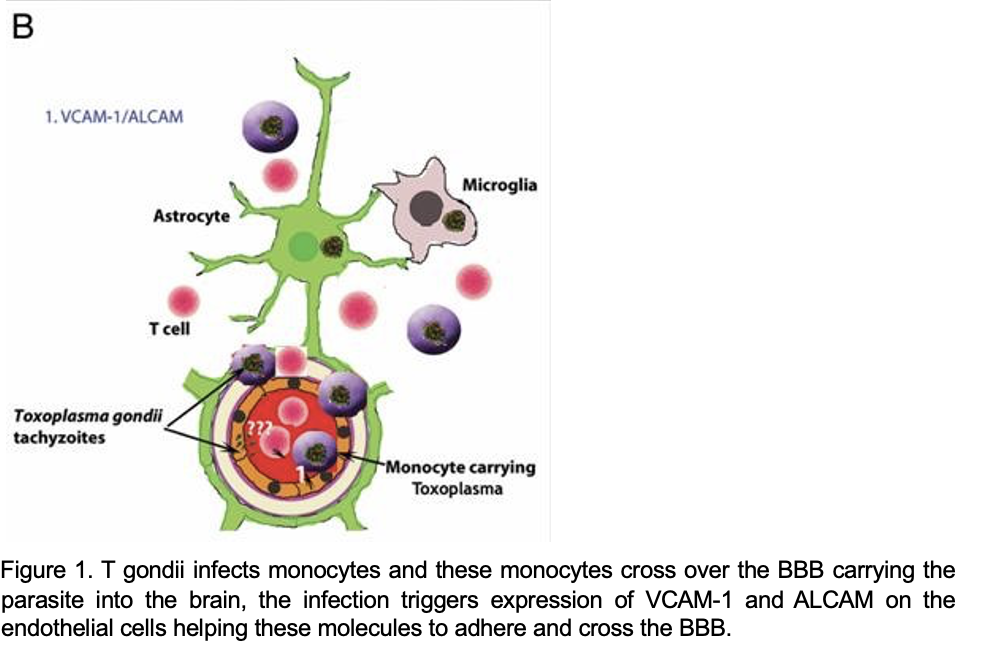
With the various mechanisms they use, the one that blows my mind is what is referred to as Trojan Horse mechanism (Figure 1). These parasites trigger an immune response, then when the macrophages and monocytes move in to rescue, they hide inside the macrophages and move into the brain with them because the brain will allow macrophages to move in of course! Once they cross the BBB, they damage delicate brain structures. In conclusion both this parasite results in devastating consequences to the host and pose a significant threat to human health and it is important that we know all the mechanisms that are used by these parasites even though it remains unclear how parasite-derived and host-derived molecules contribute to the BBB remains incomplete.
References
Christine A Northrop-Clewes, Christopher Shaw, Parasites, British Medical Bulletin, Volume 56, Issue 1, 2000, Pages 193–208, https://doi.org/10.1258/0007142001902897
Masocha, W. and Kristensson, K., 2012. Passage of parasites across the blood-brain barrier. Virulence, 3(2), pp.202-212.

 Health Science Reviews
Leave a comment