By Fiza Abdul Saleem
Finding remains on the less-travelled parts of Table Mountain has become an alarmingly common event in Cape Town, reflecting a harsh reality across the entire city. Each year, between 7 and 10% of autopsied deceased remain unidentified and must be given a state burial. While forensic pathologists lack training to handle highly decomposed, skeletonized, or burned remains, the Forensic Anthropology Cape Town (FACT) has specialized in identifying decomposed, skeletonized, or burnt remains since the 1940s.
In this study, researchers aimed to examine anthropological records from FACT-referred forensic cases across the Western Cape to explore factors affecting positive identification. Additionally, they analyzed how demographic, traumatic, and pathological characteristics of cases improve identification outcomes and assessed the contributions of FACT to the identification rates.
The methodology consisted of examining cases referred to FACT in the Western Cape between 2006 and 2018 to assess factors influencing the successful identification of unknown deceased individuals. A total of 172 cases, including 174 individuals, were referred to FACT during this time. Researchers compared demographic estimations (sex, age, stature) with legal outcomes to examine identification accuracy and FACT’s contribution to forensic investigations.
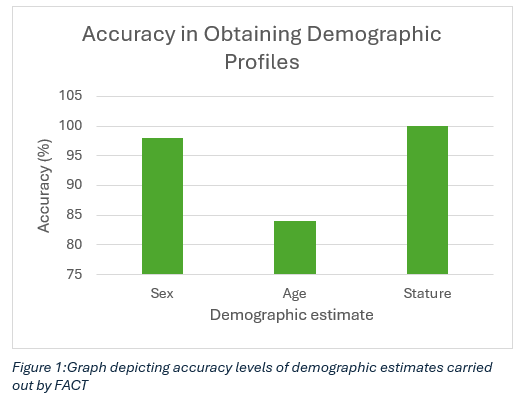
What stands out most in this paper are the results — their consistency and high accuracy speak volumes about the use of forensic anthropology as a tool for identification. The accuracy levels are illustrated in the bar graph (Figure 1). Sex was estimated with 98% accuracy, age at death with 84%, and stature with 100% accuracy (although stature comparisons were limited due to the scarcity of ante-mortem records).
Ante-mortem trauma and pathological conditions were also assessed. There was an indication of healed injuries in 41% of individuals and 69% of skeletal pathologies. The lack of access to medical records limited this identification. These characteristics would have been highly informative if linked with well-kept health records.
Out of the 168 initially unidentified individuals, 37% (61 people) were positively identified, while 49% (84 people) remained unidentified, highlighting the identification gap. While 37% may seem like a small percentage, it represents 61 individuals who were once living, now identified, and 61 families who received answers and closure. These outcomes express the important and often overlooked contribution of FACT in restoring names to the nameless and dignity to the deceased.
These findings highlight the missed potential of forensic anthropology in South Africa. If all unidentified skeletal cases were referred to anthropology labs, identification rates would likely increase, providing closure to several families. However, referrals remain inconsistent, and many cases are closed without being solved, despite the high accuracy of anthropological estimations.
Additionally, the paper also draws attention to systemic issues blocking identification efforts, such as the absence of a centralised national database for missing persons and linked healthcare records.
Moving forward, the South African Police Services and Forensic Pathology Services must make structural improvements. This includes investing in a centralised national database of missing persons and ensuring better access to medical records, which would make the identification of individuals much more efficient. Referrals to the FACT lab and any other established forensic anthropology lab should be standard practice for all skeletonised, decomposed, or burnt cases.
FACT is not just capable; it is critically needed. With high accuracy and population-specific methods, FACT proves that forensic anthropology can meaningfully contribute to decreasing the statistics associated with unidentified remains in South Africa. All that is required is the systemic support to let it do so.
References:
Baliso, A., Heathfield, L.J. & Gibbon, V.E., 2023. Forensic human identification: retrospective investigation of anthropological assessments in the Western Cape, South Africa. International Journal of Legal Medicine, 137, pp.793–807. Available at: https://doi.org/10.1007/s00414-022-02870-6.
AI usage:
| AI version | Use |
| Grammarly AI | Paraphrasing and grammar |
| GPT – 4o | Paraphrasing, grammar, and vocabulary |

 Health Science Reviews
Leave a comment