By Vhutshilo Mathoni
Imagine trying to complete a jigsaw puzzle with pieces missing. Frustrating, right? Well, that is what it is like for many families navigating the maze of rare genetic conditions. Diagnosis often feels like groping in the dark.
To solve this puzzle, researchers at Baylor College of Medicine looked at the protein-coding part of the genome- the exome – where most disease-causing variants are found. In this large study of 4476 individuals, they asked: What Makes Some Genetic Diagnoses Easier to Find Than Others, And Importantly How Can We Do Better?
By analysing clinical exome data of thousands of patients suspected of having monogenic disorder. They looked at how factors like age, clinical symptoms and family history played a role in whether a diagnosis was found.
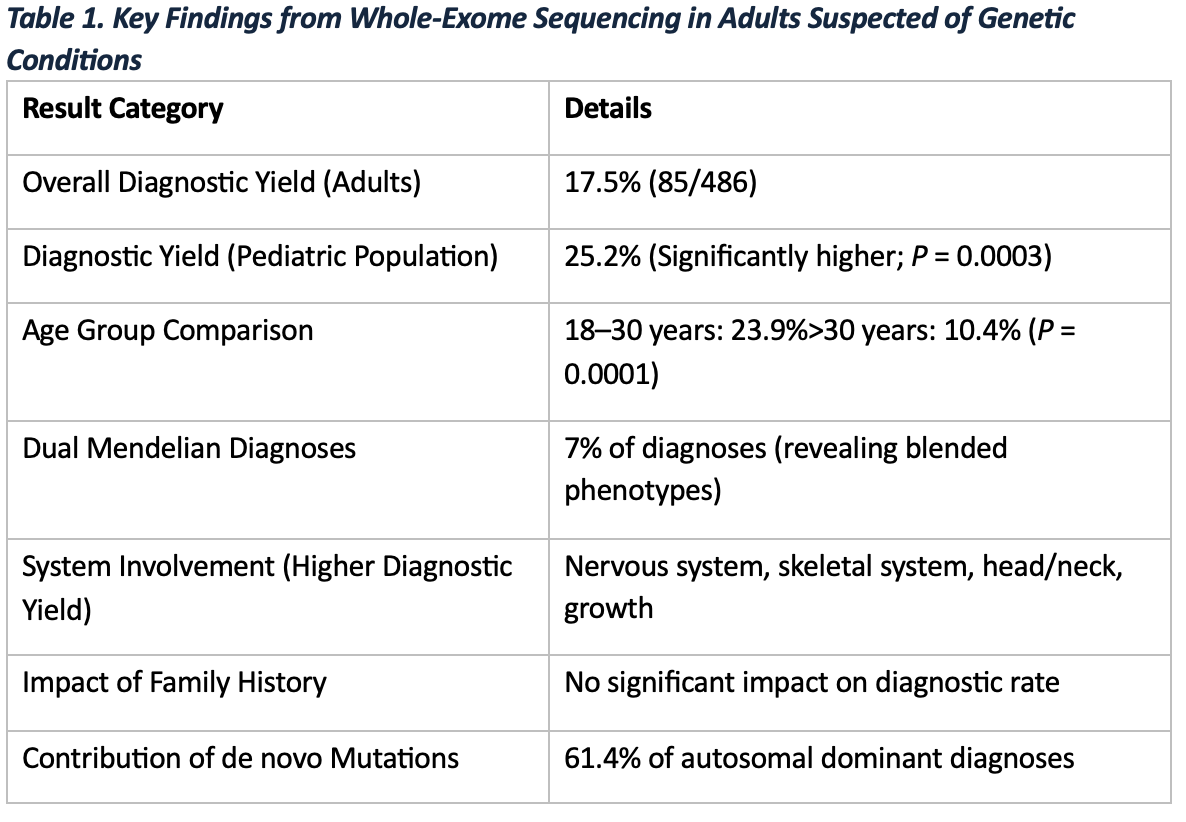
The results where astonishing: they found that, 1 in 4 people received a genetic diagnosis (Table 1). However, that number significantly increased when testing was done when there were multiple symptoms or when done in childhood. Interestingly, in cases where there was no diagnosis, there were strong hints towards genes not yet fully understood highlighting how much there is still to learn.
But one might ask: what happens to the other 75% who didn’t get a diagnosis? That is where a recent review by Wojcik and colleagues (2023) comes in
The authors recommend a tiered diagnostic approach that is cost effective and patientcentred, where testing choices are phenotype driven. Starting off with reanalysis of the exome data followed by innovative technologies like:
- Whole genome sequencing (WGS) for greater coverage
- RNA sequencing for detection of splicing and expression changes
- Epigenetic profiling for detection of regulatory changes
- Optical genome mapping for large structural variants.
These strategies provide renewed hope for patients on the diagnosis treadmill. Although a diagnosis may not be available today, it may be just around the corner.
References:
Posey, J. E., Harel, T., Liu, P., et al. (2016).Molecular diagnostic experience of whole-exome sequencing in adult patients. Genetics in Medicine, 18(7), 678–685. DOI: 10.1038/gim.2015.142 External LinkAlso available on ScienceDirect
Wojcik MH, et al. Beyond the exome: What’s next in diagnostic testing for Mendelian conditions Annu Rev Med. 2023;74:109–122. DOI: 10.1146/annurev-med-042921-110721 PMID: 37541186 PMCID: PMC10432150DOI: 10.1016/j.ajhg.2023.06.009

 Health Science Reviews
Leave a comment