By Robin Veitch
Shoulder problems can make daily living quite difficult, causing tasks dressing to become rather complex or painful. Some people with, for example, arthritis or rotator cuff tears find that conventional treatments are not always effective. This is where reverse total shoulder arthroplasty (RTSA) comes in – an surgical procedure for shoulder replacement that improves mobility and alleviates pain where other treatments have failed.
What sets RTSA apart from others? As you can see on the right, in a traditional shoulder replacement, surgeons reconstruct the joint to look like your original shoulder. See the picture below (figure 1)

Figure 1: Traditional Shoulder Arthroplasty (Hellerhoff, CC BY-SA 4.0, https://creativecommons.org/licenses/by-sa/4.0, via Wikimedia Commons)
If the stability muscles of the shoulder are badly damaged, though, this traditional strategy might not work. RTSA reverses the positions of the ball and socket, allowing other muscles like the Deltoid muscles to compensate for the strength and mobility of the shoulder (Figure 2)
As is the case with many things in life; RTSA has helped many people with shoulder problems but still has its risks. Lots of research is going into this field to figure out the best types of implants with the lowest problems. For example, A study from the UK compared a few RTSA prosthesis designs to determine their outcomes. The study found even though all the designs bettered shoulder movement, different designs led to different complications. One design, for example, led to “scapular notching,” where the implant grinds against the bone, resulting in potential pain or restricted movement.
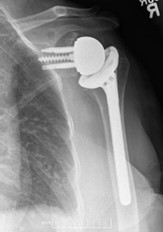
Figure 2: X-ray of a Reverse Total Shoulder Arthroplasty implant (KChri75,CC BY-SA 4.0, https://creativecommons.org/licenses/by-sa/4.0, via Wikimedia Commons)
While other designs had a lower chance of notching, they were more prone to other complications like loosening. The overral takeaway from this blog post is that it’s very important to discuss with your doctor the options and their pros and cons, because each of us is different and thus no one-size fits all solution.
References:
Kozak, T., et al. (2021). Reverse Total Shoulder Arthroplasty: Current Indications, New Designs, Same Old Problems. EFORT Open Reviews, 6, 189-201. https://doi.org/10.1302/2058-5241.6.200085
Burden, E.G., Batten, T.J., Smith, C.D., & Evans, J.P. (2021). Reverse total shoulder arthroplasty: A systematic review and meta-analysis of complications and patient outcomes dependent on prosthesis design. Bone & Joint Journal, 103-B(5), 813-821.

 Health Science Reviews
Leave a comment