By Bianca Obadic
Have you ever wondered why some people love the fiery burn of chili peppers while others cannot even handle the tang of Nando’s lemon and herb? Your first instinct, much like mine, may be to make fun of these weaklings, but what if it’s something that isn’t even under their control?
A twin study conducted by Törnwell et al. investigated the genetic and environmental factors that influence a person’s preferential spice level, and found that the answer may, in fact, lie in your genes.
How did they do this?
The participants included both identical and non-identical twins who had been brought up in the same environment. This would help answer the question of ‘nature vs nurture?’.
The twins were individually given blocks of strawberry jelly as a reference. After this, they were given strawberry jelly spiked with capsaicin, which mimics the spicy sensation of chili peppers, and asked to rate the pleasantness as either less, similar, or more pleasant than the non-spicy version. They did the same with pungency intensity (“heat-like” sensory burn). Following this, a questionnaire assessed their preferences for various spicy foods.
Participants were grouped, according to their pleasantness ratings, as likers, medium-likers, or non-likers of pungent foods. Genetic modelling was used to estimate the influence of genetic and environmental factors on their response, as well as to compare the rating similarities between monozygotic and dizygotic twins. This was followed by statistical analyses to infer correlation patterns.
So, what did they find?
For each of the observed traits, they found a higher intrapair correlations between the monozygotic twins compared to the dizygotic twins. This is indicative of an underlying genetic influence, since identical twins share all their DNA.
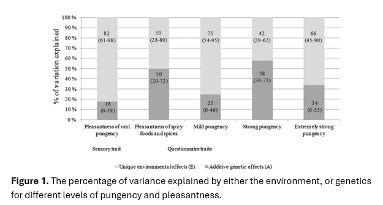
Figure 1. shows that genetic factors accounted for between 18-58% of the variation in how much participants enjoyed spicy foods and sensations, while environmental factors explained the rest. Non-likers of spicy foods perceived the capsaicin-spiked jelly as more intense and rated spicy foods as less pleasant compared to likers.
The study also found that the same genetic factors influenced the pleasantness of both spicy foods and the sensory experience of oral pungency, suggesting a common genetic basis for these preferences.
What does this tell us?
By testing twins, researchers found that while environmental factors play a role, a significant part of our reaction to spicy foods is genetic. Those who enjoy the heat often perceive the intensity differently, finding it less overwhelming and more enjoyable, while those who cannot handle it, may be inherently more sensitive to the burn.
So, the next time you find yourself sweating over a bowl of spicy curry, remember—your taste buds might just be genetically wired to love (or loathe) that fiery kick. Whether you’re a spice enthusiast or prefer milder flavours, it’s fascinating to know that your food preferences are a complex mix of nature and nurture.
Reference: Törnwall, O., Silventoinen, K., Kaprio, J., & Tuorila, H. (2012). Why do some like it hot? Genetic and environmental contributions to the pleasantness of oral pungency. Physiology & behavior, 107(3), 381–389. https://doi.org/10.1016/j.physbeh.2012.09.010

 Health Science Reviews
Leave a comment