by Siyabonga Msipa
Pancreatic ductal adenocarcinoma is the most common and aggressive form of pancreatic cancer. With only a 5-year survival rate of less than 10%, classical treatments like surgery, chemotherapy, and radiation have not shown significant improvements in clinical outcomes.
Surgery is currently the best curative treatment option for localized PDAC but due to late diagnosis about 80% of patients are ineligible for the surgery because at this stage the disease would have already progressed and spread to other parts of the body. As a result, nearly all patients are offered conventional chemotherapy. However, this only modestly increases the survival rate due to therapy resistance and associated toxicity. These are therefore some of the factors that contribute to PDAC having the worst survival rate in comparison to all other cancers.
The major difficulty in effectively treating PDAC is its tumor microenvironment which significantly contributes to therapy resistance, tumor progression and metastasis of the cancer. The tumor microenvironment refers to the environment around a tumor, which is composed of the surrounding blood vessels, different cell types, immune cells, and the extracellular matrix. It is largely composed of cancer cells which interact with these components in complex ways.

This study seeks to understand the effects of chemotherapy on the Pancreatic ductal adenocarcinoma tumor microenvironment using a technology called Single cell RNA sequencing (scRNA-seq).
Methods
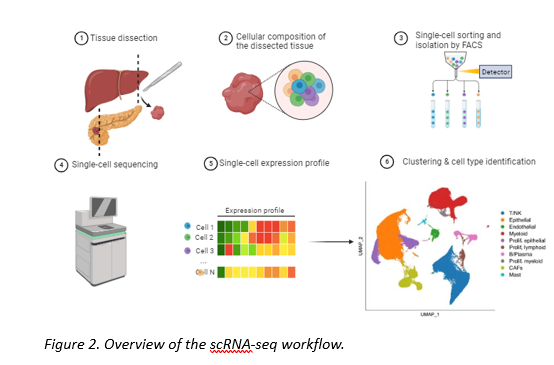
scRNA-seq is an incredible technique that helps researchers to see the differences between individual cells, within the same tissue or tumor and how they respond to treatments. To do this the researchers collected tumor samples from 27 PDAC patients. Single cells were isolated from the tumor, and their RNA was extracted, reverse transcribed into cDNA, which was then amplified and sequenced. The data was then cleaned up and was ready for further analysis. By analyzing the data generated from this sequencing the researchers could then gain information about the tumor itself and how the cells in the tumor respond to the treatment.
Results
A computational technique called unsupervised clustering combined with a method called uniform manifold approximation and projection (UMAP) was used to group cells that shared similar characteristics together. This analysis revealed ten unique cells clusters.
Three major groups of cells were identified as epithelial, T/ natural killer (NK), and myeloid cells. In addition to these major clusters, several other cell types were identified (Fig 3).

The researchers found that the epithelial compartment which refers to the cancer cells within the tumor microenvironment revealed a heterogeneous malignant subtype composition, with most tumors displaying a mixture of basal-like and classical-like cells. The classical subtype has a better prognosis, in contrast the basal subtype is associated with a more aggressive phenotype and patients respond poorly to treatment.
To understand how certain genes are active in these cancer cells in response to chemotherapy the researchers used a method called Gene Set Enrichment Analysis (GSEA). They found that the cancer cells from the chemotherapy treated group showed higher activity in genes related to processes called angiogenesis and EMT which are two critical factors that influence tumor growth and metastasis. Interestingly they observed that both the classical and basal-like cancer cells responded to the treatment in a similar way at the genetic level. In other words, the treatment didn’t cause classical cancer cells to shift to a more like basal-like expression.
Next the researchers wanted to understand how chemotherapy affected the communication between cells in the TME. PDCA is often characterised as having a highly immunosuppressive TME which means that the body’s immune system doesn’t recognize the cancer cells very well and the environment around the cancer cells suppresses the immune response.
The analysis revealed a potential effective treatment. The researchers found that a molecule called TIGIT found on the CD8 + T cells was overexpressed in the treatment naïve group. TIGIT is like a “brake” for these immune cells, stopping them from attacking normal cells. When someone has cancer, the cancer cell uses this molecule to stop immune cells from attacking them.
If TIGIT is blocked, as in release the brakes on the immune system, this can make the immune system more powerful in attacking the cancer. So, an effective therapy might involve blocking TGIT as the first-line treatment or together with chemotherapy.
Overall, scRNA-seq is a valuable technique that can be used to gain a deeper understanding of complex diseases and can help in the discovery on novel therapies that can benefit a lot of people.
Reference
Werba, G., Weissinger, D., Kawaler, E., Zhao, E., Despoina Kalfakakou, Surajit Dhara, Wang, L., Lim, H.B., Oh, G., Jing, X., Beri, N., Khanna, L., Gonda, T.A., Oberstein, P.E., Hajdu, C., Loomis, C.A., Heguy, A., Sherman, M.H., Lund, A.W. and Welling, T.H. (2023). Single-cell RNA sequencing reveals the effects of chemotherapy on human pancreatic adenocarcinoma and its tumor microenvironment. Nature Communications, [online] 14(1). doi:https://doi.org/10.1038/s41467-023-36296-4.

 Health Science Reviews
Leave a comment