by Rethabile khabo
Tasha is a 21 year college student that has experienced depression several times in her life ,One morning she was late for class and she wondered why she bothered to come, The professor’s words were drowning in the overwhelming sense of dread that she had been feeling for weeks .To make matters worse the medication prescribed by her therapist wasn’t helping , she had a lot of work and kept falling behind. “There must be another way to solve this problem”, she thought. Fortunately, she is not the only person who has asked this question. Oddly, the answer to this question is living in her gut.
Microorganisms especially bacteria living in the gut have been associated with several physiological processes in the body such as digestion and immunity. These microbes are also part of the gut -brain axis which is a communication network between the gut and the brain. Therefore, dysbiosis in the gut is linked to multiple mental health disorders such as depression and anxiety(Rathour et al., 2023). Although treatment is available, only 60 -70 percent of patients are responsive, making it necessary to find alternatives. In one study, researchers wanted to determine the effect of probiotics on dysbiosis and stress.
To achieve this, the researchers induced chronic stress in 30 male adult C57BL/6 mice. The mice were then randomly divided into 3 groups (10 of each). The first group was left untreated while other two groups were treated with either an anti-depressant, fluoxetine, or Bifidobacterium breve. A non-stress control group was also included in the analysis. After 5 weeks of treatment, behavioural indicators, microbial distribution in the gut, serotonin levels and inflammation markers were measured.
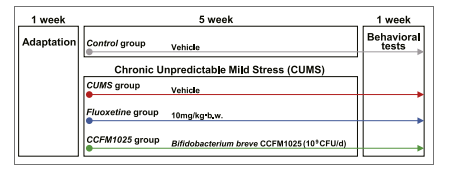
Figure 1. Experimental Period outline.
The results show that Bifidobacterium breve reduced stress induced behaviour and inflammation in the chronically stressed mice. It also increased serum and hippocampal serotonin concentrations which have anti-depressant effects. In contrast, its relative Bifidobacterium psuedolongum is linked to depression. Interestingly, Bifidobacterium breve also restored some microbial populations in the gut ,suggesting that probiotics are effective against dysbiosis (Tian et al., 2020).

Figure 2. Bifidobacterium treatment decreases immobility due to stress. Panel shown in A is heatmap that tracks movement, and the histogram represents time spent in open area. #, *-denote that results are significant.

Figure 3. Bifidobacterium treatment increases serotonin levels. A and B-Histograms showing increased serum and hippocampal serotonin respectively. #, *-denote that results are significant.
Overall, using probiotics to treat dysbiosis and mental health disorders seems quite plausible. However, the mice response may not accurately mimic what happens in humans, so more studies are required to confirm the observed results. Also, high specificity is necessary or else instead of helping, these microbes could exacerbate the problem. Otherwise, having tiny organisms live inside your gut can be a good thing, sometimes.
References
Rathour, D., Shah, S., Khan, S., Singh, P. K., Srivastava, S., Singh, S. B., & Khatri, D. K. (2023). Role of gut microbiota in depression: Understanding molecular pathways, recent research, and future direction. Behavioural Brain Research, 436, 114081.
Tian, P., O’Riordan, K. J., Lee, Y.-k., Wang, G., Zhao, J., Zhang, H., Cryan, J. F., & Chen, W. (2020). Towards a psychobiotic therapy for depression: Bifidobacterium breve CCFM1025 reverses chronic stress-induced depressive symptoms and gut microbial abnormalities in mice. Neurobiology of stress, 12, 100216.

 Health Science Reviews
Leave a comment